Diagnostics of subspaces obtained from split replication CV

Author

Saikat Banerjee

Published

June 2, 2026

Abstract
This notebook documents the diagnostics of subspaces obtained from PGC data using NNM-Corr model and PGD-AFW solver.

Background

We expected the projection distance between subspaces to be monotonically decreasing. For the NNM-Corr model, we found that the projection distances between subspaces are very noisy. Click here to view the analysis notebook.

Here, we try to diagnose the source of this noise.

Code
import re
import json
import pickle
from pathlib import Path
import numpy as np
import pandas as pd

import matplotlib.pyplot as plt
from pymir import mpl_stylesheet
from pymir import mpl_utils
mpl_stylesheet.banskt_presentation(splinecolor = 'black', dpi = 300)

from matplotlib import colormaps as mpl_cmaps
import matplotlib.colors as mpl_colors
from mpl_toolkits.axes_grid1 import make_axes_locatable
Code
data_root = "/gpfs/commons/groups/knowles_lab/data/PsychGen/analysis/clorinn/cv_split_replication"
prefix = "pgd_afw_nnm_corr"
stability_out_dir = Path(data_root) / "stability"
subspace_out_dir = Path(data_root) / "subspace"
fit_result_out_dir = Path(data_root) / "fit_result"
Code
def load_stability_jsons(stability_dir, prefix):
    stability_dir = Path(stability_dir)
    paths = sorted(stability_dir.glob(f"{prefix}_r*.json"))

    records = []
    for path in paths:
        with open(path) as fh:
            rec = json.load(fh)
        rec["_path"] = str(path)
        records.append(rec)

    return records


def build_by_k_metrics_grid(records, metric, *, duplicate="error"):
    rows = []

    for rec in records:
        nucnorm = int(round(float(rec["nucnorm"])))

        for entry in rec["by_k"]:
            value = entry[metric]
            rows.append({
                "nucnorm": nucnorm, 
                "k": int(entry["k"]), 
                metric: float(value),
            })

    long_df = pd.DataFrame(rows)

    dup_mask = long_df.duplicated(subset=["nucnorm", "k"], keep=False)
    # Look for duplicates. This can happen if coarse and fine grids
    # contain the same nucnorm.
    if dup_mask.any():
        keep = "first" if duplicate == "first" else "last"
        long_df = (
            long_df
            .sort_values(["nucnorm", "k"])
            .drop_duplicates(subset=["nucnorm", "k"], keep=keep)
        )
    grid_df = (
        long_df
        .pivot(index="k", columns="nucnorm", values=metric)
        .sort_index(axis=0)
        .sort_index(axis=1)
    )

    grid_df.index.name = "k"
    grid_df.columns.name = "nucnorm"

    return grid_df

The Problem

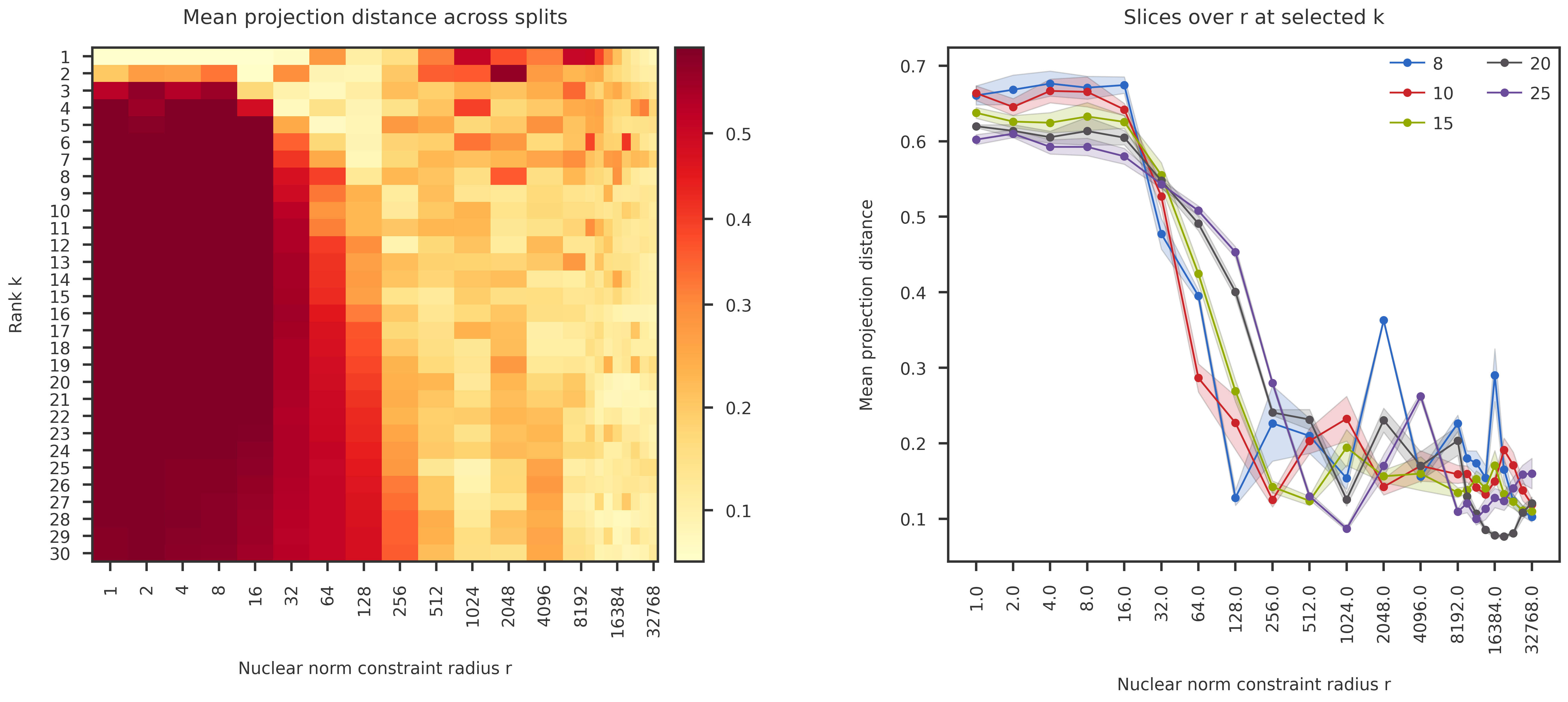
The solution path is not smooth. There are spikes along the projected distance matrix. We reproduce the heatmap here for posterity.

Code
def centers_to_edges(x):
    x = np.asarray(x, dtype=float)
    edges = np.empty(len(x) + 1)
    edges[1:-1] = 0.5 * (x[:-1] + x[1:])
    edges[0] = x[0] - 0.5 * (x[1] - x[0])
    edges[-1] = x[-1] + 0.5 * (x[-1] - x[-2])
    return edges

def plot_heatmap(ax, X, rank_list, k_list,
        vmin=0, vcenter=0.9, vmax=1.0,
        scale="log2"):

    cmap1 = mpl_cmaps.get_cmap("YlOrRd").copy()
    cmap1.set_bad("w")
    norm1 = mpl_colors.TwoSlopeNorm(vmin=vmin, vcenter=vcenter, vmax=vmax)

    r, rticks, rlabels = get_r_scaled(rank_list, scale=scale)

    x_edges = centers_to_edges(r)
    y_edges = np.arange(len(k_list) + 1) - 0.5

    im1 = ax.pcolormesh(x_edges, y_edges, X, cmap=cmap1, norm=norm1, shading="auto")

    # match imshow(origin="upper")
    ax.set_ylim(len(k_list) - 0.5, -0.5)

    divider = make_axes_locatable(ax)
    cax = divider.append_axes("right", size="5%", pad=0.2)
    cbar = plt.colorbar(im1, cax=cax, fraction=0.1)

    ax.set_xlabel("Nuclear norm constraint radius r")
    ax.set_ylabel("Rank k")

    ax.set_yticks(np.arange(len(k_list)))
    ax.set_yticklabels([str(int(k)) for k in k_list])

    ax.set_xticks(rticks)
    ax.set_xticklabels([str(int(r)) for r in rlabels], rotation=90)

    return im1

def plot_heatmap_(ax, X, rank_list, k_list,
        vmin = 0, vcenter = 0.9, vmax = 1.0):
    cmap1 = mpl_cmaps.get_cmap("YlOrRd").copy()
    cmap1.set_bad("w")
    norm1 = mpl_colors.TwoSlopeNorm(vmin = vmin, vcenter = vcenter, vmax = vmax)
    im1 = ax.imshow(X, cmap = cmap1, norm = norm1, origin = 'upper', aspect='auto')
    
    divider = make_axes_locatable(ax)
    cax = divider.append_axes("right", size="5%", pad=0.2)
    cbar = plt.colorbar(im1, cax=cax, fraction = 0.1)

    ax.set_xlabel("Nuclear norm constraint radius r")
    ax.set_ylabel("Rank k")
    ax.set_yticks(np.arange(len(k_list)))
    ax.set_yticklabels([str(int(k)) for k in k_list])
    ax.set_xticks(np.arange(len(rank_list)))
    ax.set_xticklabels([str(int(r)) for r in rank_list], rotation=90)    
    return

def get_r_scaled(x, scale="log2"):
    x = np.asarray(x, dtype=float)
    powers = np.arange(np.ceil(np.log2(x.min())), np.floor(np.log2(x.max())) + 1)
    xlabels = 2 ** powers
    
    if scale == "log10":
        xscale = np.log10(x)
        xticks = np.log10(xlabels)
    elif scale == "log2":
        xscale = np.log2(x)
        xticks = np.log2(xlabels)
    else:
        xscale = x
        xticks = xlabels

    return xscale, xticks, xlabels

def make_projection_distance_figure(prefix,
        vmin=0.09, vcenter=0.12, vmax=0.2):
    records = load_stability_jsons(stability_out_dir, prefix)
    dist_df = build_by_k_metrics_grid(records, "mean_dist", duplicate="first")
    se_dist_df = build_by_k_metrics_grid(records, "se_dist", duplicate="first")
    rank_list = dist_df.columns.to_numpy()
    k_list = dist_df.index.to_numpy()
 
    fig = plt.figure(figsize=(18, 8), constrained_layout=True)
    gs = fig.add_gridspec(nrows=1, ncols=2, 
                          width_ratios=[1, 1],  # heatmap, line plot
                          wspace=0.2, hspace=0.05,
                         )
    ax1 = fig.add_subplot(gs[0, 0])
    ax2 = fig.add_subplot(gs[0, 1])

    im1 = plot_heatmap(ax1, dist_df.to_numpy(), rank_list, k_list, 
                 vmin=vmin, vcenter=vcenter, vmax=vmax)
    ax1.set_title("Mean projection distance across splits", pad = 20)

    # Plot rows of the heatmap as a line plot. 
    # Makes it easier to see the plateau onset for chosen ranks.
    k_choose = [8, 10, 15, 20, 25]
    r, rticks, rlabels = get_r_scaled(rank_list, scale='log2')
    for k in k_choose:
        y = dist_df.loc[k].to_numpy()
        se = se_dist_df.loc[k].to_numpy()
        ax2.plot(r, y, 'o-', label=f"{k:d}")
        ax2.fill_between(r, y - se, y + se, alpha=0.2)
    ax2.set_xlabel("Nuclear norm constraint radius r")
    ax2.set_ylabel(f"Mean projection distance")
    ax2.set_xticks(rticks)
    ax2.set_xticklabels(rlabels, rotation=90)
    ax2.set_title(f"Slices over r at selected k", pad = 20)
    ax2.legend(loc = 'upper right', frameon = False, handlelength = 2, ncol = 2)
    
    plt.show()
    

vmin, vcenter, vmax = 0.05, 0.3, 0.6
make_projection_distance_figure(prefix, vmin=vmin, vcenter=vcenter, vmax=vmax)

At k=20, the projection distance decreases up to r=1024 and then spikes at r=2048, oscillates at r=4096 and r=8192 before tapering off.

At k=10 and k=15, the projection distance spikes at r=1024 before tapering off.

At k=25, the projection distance spikes at r=4096 before tapering off.

Let’s look at some suspicious cells:

(k=6,  r=19484)**
(k=8,  r=2048)**
(k=10, r=512)
(k=10, r=1024)
(k=15, r=1024)
(k=20, r=2048)
(k=20, r=8192)
(k=25, r=4096)
Code
suspicious_cells=[
    (6, 19484),
    (8, 2048),
    (10, 512),
    (10, 1024),
    (15, 1024),
    (20, 2048),
    (20, 8192),
    (25, 4096),
]

Look at per-repeat distances, not only the mean

Code
def build_metrics_per_pair(records, metric):
    rows = []

    for rec in records:
        nucnorm = int(round(float(rec["nucnorm"])))

        pair_labels = rec["pair_labels"]
        for entry in rec["by_k"]:
            pair_values = entry[metric]
            k = int(entry["k"])
            for label, value in zip(pair_labels, pair_values):
                rows.append({
                    "nucnorm": nucnorm, 
                    "k": k, 
                    "pair_label": label,
                    metric: float(value),
                })

    long_df = pd.DataFrame(rows)
    return long_df

def print_metrics_per_pair(long_df, cells, metric):
    for (k, r) in cells:
        query_str = f"k == {k} and nucnorm == {r}"
        values = long_df.query(query_str)[metric].to_list()
        values_str = ", ".join([f"{d:.3f}" for d in values])
        print(f"(k={k}, r={r}) \t {values_str}")

records = load_stability_jsons(stability_out_dir, prefix)
dist_df = build_by_k_metrics_grid(records, "mean_dist", duplicate="first")
dist_long_df = build_metrics_per_pair(records, "distances")
print_metrics_per_pair(dist_long_df, suspicious_cells, "distances")
(k=6, r=19484)   0.415, 0.422, 0.427, 0.392, 0.386
(k=8, r=2048)    0.362, 0.359, 0.369, 0.365, 0.360
(k=10, r=512)    0.203, 0.243, 0.232, 0.149, 0.188
(k=10, r=1024)   0.146, 0.318, 0.274, 0.225, 0.199
(k=15, r=1024)   0.220, 0.267, 0.198, 0.154, 0.133
(k=20, r=2048)   0.249, 0.283, 0.220, 0.199, 0.203
(k=20, r=8192)   0.170, 0.223, 0.240, 0.240, 0.144
(k=25, r=4096)   0.247, 0.262, 0.257, 0.265, 0.279

Check objective monotonicity per split

Code
def build_convergence_per_split(rank_list, n_repeat=5, n_split=2):
    ranks = np.asarray(rank_list)
    rows = []
    for r in np.unique(ranks):
        for s in range(n_repeat):
            fit_result_out_path = fit_result_out_dir / f"{prefix}_r{r}_s{s}.pkl"
            with open(fit_result_out_path, 'rb') as f:
                fit_result = pickle.load(f)
            for i in range(n_split):
                loss = np.array(fit_result[i]['final_result'].history.loss)
                relative_loss = (loss[-2] - loss[-1]) / loss[-2]
                rows.append({
                    "nucnorm": r,
                    "repeat": s,
                    "split": i,
                    "loss": fit_result[i]['final_result'].loss,
                    "rel_loss": relative_loss,
                    "duality_gap": fit_result[i]['final_result'].duality_gap,
                    "nuclear_norm": fit_result[i]['final_result'].metrics['nuclear_norm'],
                })
    df = pd.DataFrame(rows)
    return df
            
rank_list = dist_df.columns.to_list()
convergence_df = build_convergence_per_split(rank_list)
Code
convergence_df.query("repeat==0 and split==0")
nucnorm repeat split loss rel_loss duality_gap nuclear_norm
0 1 0 0 2.617907e+06 9.510999e-13 2.528538e-06 0.707107
10 2 0 0 2.616726e+06 1.090869e-13 2.739350e-07 1.414214
20 4 0 0 2.614456e+06 1.342524e-11 3.757306e-05 2.828427
30 8 0 0 2.610283e+06 1.218090e-10 4.249882e-04 5.656854
40 16 0 0 2.603314e+06 2.312553e-11 2.910869e-01 11.313708
50 32 0 0 2.591879e+06 8.634181e-12 6.933025e-01 22.627417
60 64 0 0 2.572111e+06 4.154924e-12 8.730343e-01 45.254834
70 128 0 0 2.538881e+06 1.163566e-12 9.898658e-01 90.509668
80 256 0 0 2.486307e+06 6.658172e-13 1.468620e+00 181.019334
90 512 0 0 2.399024e+06 3.935152e-10 5.830802e+01 362.038216
100 1024 0 0 2.250455e+06 6.905272e-09 3.872264e+02 724.070872
110 2048 0 0 2.006504e+06 2.891786e-08 1.059209e+03 1448.051020
120 4096 0 0 1.630454e+06 1.405536e-07 4.073769e+03 2895.180206
130 8192 0 0 1.092280e+06 5.571455e-07 1.077245e+04 5783.911833
140 9742 0 0 9.322953e+05 1.582833e-06 1.825762e+04 6873.279805
150 11585 0 0 7.607587e+05 1.654492e-06 2.089252e+04 8165.564799
160 13777 0 0 5.800457e+05 1.076319e-06 1.572706e+04 9710.450732
170 16384 0 0 4.497604e+05 3.412998e-05 1.078002e+05 11006.159093
180 19484 0 0 3.441126e+05 1.470223e-04 2.005601e+05 12214.728523
190 23170 0 0 2.444248e+05 4.500538e-04 3.001847e+05 13558.782202
200 27554 0 0 1.629455e+05 2.672674e-04 4.166482e+05 14907.297019
210 32768 0 0 1.100692e+05 1.362076e-04 9.056654e+05 16001.975588

Objective monotonicity is good. But the high-r fits do not look fully solved because the fitted nuclear norm falls far below the available radius while the duality gap becomes large.

Are the spikes caused by small spectral gaps?

Code
def _pair_to_mat_indices(pair_labels, mat_labels):
    """
    Map each pair label 'A-B' to (mat_idx_A, mat_idx_B).
    """
    mat_to_idx = {label: i for i, label in enumerate(mat_labels)}
    return [tuple(mat_to_idx[s] for s in pl.split("-")) for pl in pair_labels]

def _pair_label_to_repeat_fold_ids(pair_label):
    # 'rep0_f0-rep0_f1', 'rep1_f0-rep1_f1', ...
    pattern = r"rep(\d+)_f(\d+)-rep(\d+)_f(\d+)"
    m = re.match(pattern, pair_label)
    repeat_id = int(m.group(1))
    if repeat_id != int(m.group(3)):
        raise ValueError(f"Repeat IDs dont match: {m.group(1)} and {m.group(3)}")
    fold_id_1 = int(m.group(2))
    fold_id_2 = int(m.group(4))
    return repeat_id, fold_id_1, fold_id_2

def spectral_gap_from_record(record):
    rows = []

    nucnorm     = int(round(float(record["nucnorm"])))
    mat_labels  = record["mat_labels"]
    pair_labels = record["pair_labels"]
    n_matrices  = record["n_matrices"]
    n_pairs     = record["n_pairs"]
    
    by_k = sorted(record["by_k"], key=lambda x: int(x["k"]))
    cum_energy = np.array([e["energies"]  for e in by_k], dtype=np.float64)  # (n_factors, n_mats)
    dist_kp    = np.array([e["distances"] for e in by_k], dtype=np.float64)  # (n_factors, n_pairs)  
    k_values   = [int(e["k"]) for e in by_k]

    E0 = np.zeros((1, n_matrices), dtype=float)
    E = np.vstack([E0, cum_energy])
    
    delta_E = np.diff(E, axis=0) # rows corresponding to k_values
    delta_E = np.clip(delta_E, 0.0, None) # Numerical cleanup
    
    # normalized singular values: s_k / ||s||_2
    s_norm = np.sqrt(delta_E)
    
    pair_mats  = _pair_to_mat_indices(pair_labels, mat_labels)
    for p, (ia, ib) in enumerate(pair_mats):
        for idx, k in enumerate(k_values):
            row = {
                "nucnorm": nucnorm,
                "k": k,
                "pair_label": pair_labels[p],
                "pair_idx": p,
                "distance": dist_kp[idx, p],
                "energy": np.nanmin([cum_energy[idx, ia], cum_energy[idx, ib]]),
                "s_norm": np.nanmin([s_norm[idx, ia], s_norm[idx, ib]]),
            }
            # Gap at k requires k+1, so cannot compute for the last stored k.
            if idx + 1 < len(k_values):
                s_ka, s_kb = s_norm[idx, ia], s_norm[idx, ib]
                s_next_a, s_next_b = s_norm[idx + 1, ia], s_norm[idx + 1, ib]
                
                gap_a = s_ka - s_next_a
                gap_b = s_kb - s_next_b
                
                rel_gap_a = gap_a / s_ka if s_ka > 0 else np.nan
                rel_gap_b = gap_b / s_kb if s_kb > 0 else np.nan
                
                gap_ratio_a = s_next_a / s_ka if s_ka > 0 else np.nan
                gap_ratio_b = s_next_b / s_kb if s_kb > 0 else np.nan

                row.update({
                    "s_gap": np.nanmin([gap_a, gap_b]),
                    "rel_s_gap": np.nanmin([rel_gap_a, rel_gap_b]),
                    "gap_ratio": np.nanmax([gap_ratio_a, gap_ratio_b]),
                })
            else:
                row.update({
                    "s_gap": np.nan,
                    "rel_s_gap": np.nan,
                    "gap_ratio": np.nan,
                })

            rows.append(row)
    return rows

def load_subspace_npz(subspace_dir, prefix):
    subspace_dir = Path(subspace_dir)
    rows = []
    for path in subspace_dir.glob(f"{prefix}_r*.npz"):
        with np.load(path, allow_pickle=False) as data:
            n_folds = int(data["n_folds"])
            nucnorm = data["nucnorm"].item()
            repeat_id = data["repeat_id"].item()
            for f in range(n_folds):
                s = data[f"s_f{f}"]
                n_factors = len(s)
                row = {
                    "nucnorm": nucnorm,
                    "repeat_id": repeat_id,
                    "fold_id": f,
                }
                row.update({f"s{k}": s[k] for k in range(n_factors)})
                rows.append(row)
    df = (pd.DataFrame(rows)
              .sort_values(["nucnorm","repeat_id", "fold_id"])
              .reset_index(drop=True))
    return df


def spectral_gap_from_subspace(subspace_df, record):
    
    def get_subspace_spectrum(subspace_df, repeat_id, fold_id):
        df = subspace_df[
                (subspace_df["repeat_id"] == repeat_id) &
                (subspace_df["fold_id"] == fold_id)
            ].reset_index(drop=True)
        return df.sort_values(["nucnorm"]).reset_index(drop=True)
    
    def get_eigvalue(df, r, k_idx):
        return float(df[df["nucnorm"] == r][f"s{k_idx}"].iloc[0])
    
    rows = []

    nucnorm     = int(round(float(record["nucnorm"])))
    mat_labels  = record["mat_labels"]
    pair_labels = record["pair_labels"]
    n_matrices  = record["n_matrices"]
    n_pairs     = record["n_pairs"]
    
    by_k = sorted(record["by_k"], key=lambda x: int(x["k"]))
    dist_kp    = np.array([e["distances"] for e in by_k], dtype=np.float64)  # (n_factors, n_pairs)  
    k_values   = [int(e["k"]) for e in by_k]
    
    for p, pair_label in enumerate(pair_labels):
        repeat_id, fold_id_1, fold_id_2 = _pair_label_to_repeat_fold_ids(pair_label)
        df_fold_1 = get_subspace_spectrum(subspace_df, repeat_id, fold_id_1)
        df_fold_2 = get_subspace_spectrum(subspace_df, repeat_id, fold_id_2)
        s_0a = get_eigvalue(df_fold_1, nucnorm, 0)
        s_0b = get_eigvalue(df_fold_2, nucnorm, 0)
        for idx, k in enumerate(k_values):
            s_ka = get_eigvalue(df_fold_1, nucnorm, idx)
            s_kb = get_eigvalue(df_fold_2, nucnorm, idx)
            row = {
                "nucnorm": nucnorm,
                "k": k,
                "pair_label": pair_label,
                "pair_idx": p,
                "distance": dist_kp[idx, p],
                "eigvalue": np.min([s_ka, s_kb]),
                "s_norm": np.nanmin([s_ka/s_0a, s_kb/s_0b])
            }
            
            # Gap at k requires k+1, so cannot compute for the last stored k.
            if idx + 1 < len(k_values):
                s_next_a = get_eigvalue(df_fold_1, nucnorm, idx+1)
                s_next_b = get_eigvalue(df_fold_2, nucnorm, idx+1)
                
                gap_a = s_ka - s_next_a
                gap_b = s_kb - s_next_b
                
                rel_gap_a = gap_a / s_ka if s_ka > 0 else np.nan
                rel_gap_b = gap_b / s_kb if s_kb > 0 else np.nan
                
                gap_ratio_a = s_next_a / s_ka if s_ka > 0 else np.nan
                gap_ratio_b = s_next_b / s_kb if s_kb > 0 else np.nan

                row.update({
                    "s_gap": np.nanmin([gap_a, gap_b]),
                    "rel_s_gap": np.nanmin([rel_gap_a, rel_gap_b]),
                    "gap_ratio": np.nanmax([gap_ratio_a, gap_ratio_b]),
                })
            else:
                row.update({
                    "s_gap": np.nan,
                    "rel_s_gap": np.nan,
                    "gap_ratio": np.nan,
                })

            rows.append(row)
    return rows
    
def build_spectral_gap_pair(records, subspace = None):
    rows = []
    for record in records:
        if subspace is None:
            rows.extend(spectral_gap_from_record(record))
        else:
            rows.extend(spectral_gap_from_subspace(subspace, record))

    return (
        pd.DataFrame(rows)
        .sort_values(["k", "nucnorm", "pair_idx"])
        .reset_index(drop=True)
    )

subspace_df = load_subspace_npz(subspace_out_dir, prefix)
energy_df = build_spectral_gap_pair(records, subspace = subspace_df)
Code
energy_df
nucnorm k pair_label pair_idx distance eigvalue s_norm s_gap rel_s_gap gap_ratio
0 1 1 rep0_f0-rep0_f1 0 0.025156 0.707107 1.000000 0.707107 1.0 4.015523e-16
1 1 1 rep1_f0-rep1_f1 1 0.016287 0.707107 1.000000 0.707107 1.0 3.647497e-16
2 1 1 rep2_f0-rep2_f1 2 0.020491 0.707107 1.000000 0.707107 1.0 6.371862e-16
3 1 1 rep3_f0-rep3_f1 3 0.024985 0.707107 1.000000 0.707107 1.0 5.312698e-16
4 1 1 rep4_f0-rep4_f1 4 0.021932 0.707107 1.000000 0.707107 1.0 6.021974e-16
... ... ... ... ... ... ... ... ... ... ...
3295 32768 30 rep0_f0-rep0_f1 0 0.114999 155.626146 0.226711 NaN NaN NaN
3296 32768 30 rep1_f0-rep1_f1 1 0.121499 156.804912 0.231988 NaN NaN NaN
3297 32768 30 rep2_f0-rep2_f1 2 0.150105 158.057960 0.230397 NaN NaN NaN
3298 32768 30 rep3_f0-rep3_f1 3 0.112334 156.312662 0.230464 NaN NaN NaN
3299 32768 30 rep4_f0-rep4_f1 4 0.129132 157.230692 0.231378 NaN NaN NaN

3300 rows × 10 columns

Code
from scipy.stats import spearmanr

def make_gap_distance_scatter(ax, energy_df,
        x="gap_ratio", y="distance", add_fit=True,
        k_values=None, nucnorm_values=None, marker_size=40,
        min_s_norm=0.01, max_distance=0.5, min_gap_ratio=0.6, 
        color_by="nucnorm", cmap="viridis", color_norm=None):
    
    df = energy_df.copy()

    df = df[df["s_norm"] > min_s_norm]
    df = df[df["distance"] < max_distance]
    df = df.replace([np.inf, -np.inf], np.nan)
    df = df.dropna(subset=[x, y, color_by])
    
    labels = {
        "gap_ratio": "Gap ratio",
        "neglog_rel_gap": "Negative log relative gap",
        "distance": "Projection distance",
    }
    
    if x == "gap_ratio":
        df = df[df["gap_ratio"] > min_gap_ratio]

    if k_values is not None:
        df = df[df["k"].isin(k_values)]

    if nucnorm_values is not None:
        df = df[df["nucnorm"].isin(nucnorm_values)]

    rho, pval = spearmanr(df[x], df[y])

    sc = ax.scatter(df[x], df[y], 
        c=df[color_by],
        cmap=cmap,
        norm=color_norm, alpha=0.8, s=marker_size)
        

    if add_fit:
        xv = df[x].to_numpy(dtype=float)
        yv = df[y].to_numpy(dtype=float)

        m, b = np.polyfit(xv, yv, deg=1)

        # Use visible x-range for the fit line
        xlo, xhi = ax.get_xlim()
        xfit = np.linspace(xlo, xhi, 200)
        yfit = m * xfit + b

        ax.plot(xfit, yfit, lw=2, color='gray',label=f"y={m:.3g}x+{b:.3g}")
        ax.legend(frameon=False)

    ax.set_xlabel(labels[x])
    ax.set_ylabel(labels[y])
    ax.set_title(f"{labels[y]} vs {labels[x]}\nSpearman rho={rho:.3f}, p={pval:.2g}, n={len(df)}", pad=20)

    return df, sc

fig = plt.figure(figsize=(18, 8), constrained_layout=True)
gs = fig.add_gridspec(nrows=1, ncols=2, 
                      width_ratios=[1, 1],  # heatmap, line plot
                      wspace=0.1, hspace=0.05,
                     )
ax1 = fig.add_subplot(gs[0, 0])
ax2 = fig.add_subplot(gs[0, 1])
nucnorm_values = rank_list[8:14]
k_values = np.arange(5, 26)
energy_df["neglog_rel_gap"]   = -np.log10(energy_df["rel_s_gap"].clip(lower=1e-12))

# color_norm = mpl_colors.LogNorm(vmin=np.min(nucnorm_values), vmax=np.max(nucnorm_values))
color_norm = mpl_colors.BoundaryNorm(boundaries=[0] + nucnorm_values, ncolors=256)

df_gap_ratio, sc = make_gap_distance_scatter(ax1, energy_df, x="gap_ratio", 
                          nucnorm_values=nucnorm_values, k_values=k_values, color_norm=color_norm)
df_rel_gap, _    = make_gap_distance_scatter(ax2, energy_df, x="neglog_rel_gap", 
                          nucnorm_values=nucnorm_values, k_values=k_values, color_norm=color_norm)

cbar = fig.colorbar(sc, ax=[ax1, ax2], pad=0.02)
cbar.set_label("Nuclear norm radius r")
cbar.set_ticks(nucnorm_values)
cbar.set_ticklabels([str(int(r)) for r in nucnorm_values])

for label, ax in zip(["(a)", "(b)"], [ax1, ax2]):
    ax.text(-0.1, 1.1, label, transform=ax.transAxes, fontweight='bold')
    
# fig.savefig(
#         f"figures/cvsr_nnmcorr_gap_distance_scatter.pdf",
#         bbox_inches="tight",
#     )

plt.show()

Code
energy_mean_df = (
    energy_df
    .groupby(["nucnorm", "k"], as_index=False)
    .agg(
        distance=("distance", "mean"),
        gap_ratio=("gap_ratio", "mean"),
        rel_s_norm_gap=("rel_s_gap", "mean"),
        neglog_rel_gap=("neglog_rel_gap", "mean"),
        s_norm=("s_norm", "mean"),
    )
)

fig = plt.figure(figsize=(18, 8), constrained_layout=True)
gs = fig.add_gridspec(nrows=1, ncols=2, 
                      width_ratios=[1, 1],  # heatmap, line plot
                      wspace=0.1, hspace=0.05,
                     )
ax1 = fig.add_subplot(gs[0, 0])
ax2 = fig.add_subplot(gs[0, 1])
nucnorm_values = rank_list[8:14]
k_values = np.arange(5, 26)
color_norm = mpl_colors.LogNorm(vmin=np.min(nucnorm_values), vmax=np.max(nucnorm_values))

_, sc = make_gap_distance_scatter(ax1, energy_mean_df, x="gap_ratio", marker_size=100,
                          nucnorm_values=nucnorm_values, k_values=k_values, color_norm = color_norm)
_, _  = make_gap_distance_scatter(ax2, energy_mean_df, x="neglog_rel_gap", marker_size=100,
                          nucnorm_values=nucnorm_values, k_values=k_values, color_norm = color_norm)

cbar = fig.colorbar(sc, ax=[ax1, ax2], pad=0.02)
cbar.set_label("Nuclear norm radius r")
cbar.set_ticks(nucnorm_values)
cbar.set_ticklabels([str(int(r)) for r in nucnorm_values])

for label, ax in zip(["(a)", "(b)"], [ax1, ax2]):
    ax.text(-0.1, 1.1, label, transform=ax.transAxes, fontweight='bold')
    
fig.savefig(
        f"figures/cvsr_nnmcorr_gap_distance_scatter.pdf",
        bbox_inches="tight",
    )

plt.show()

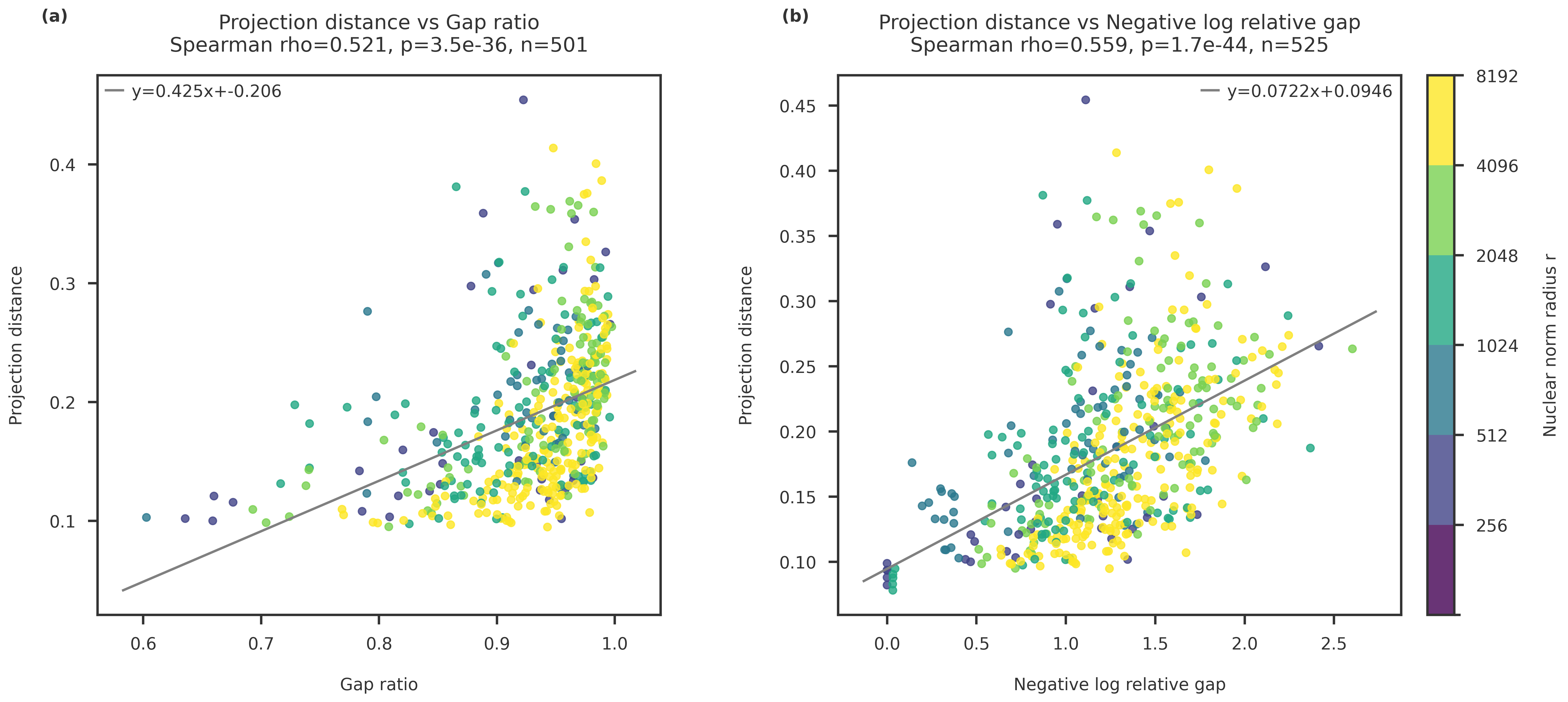
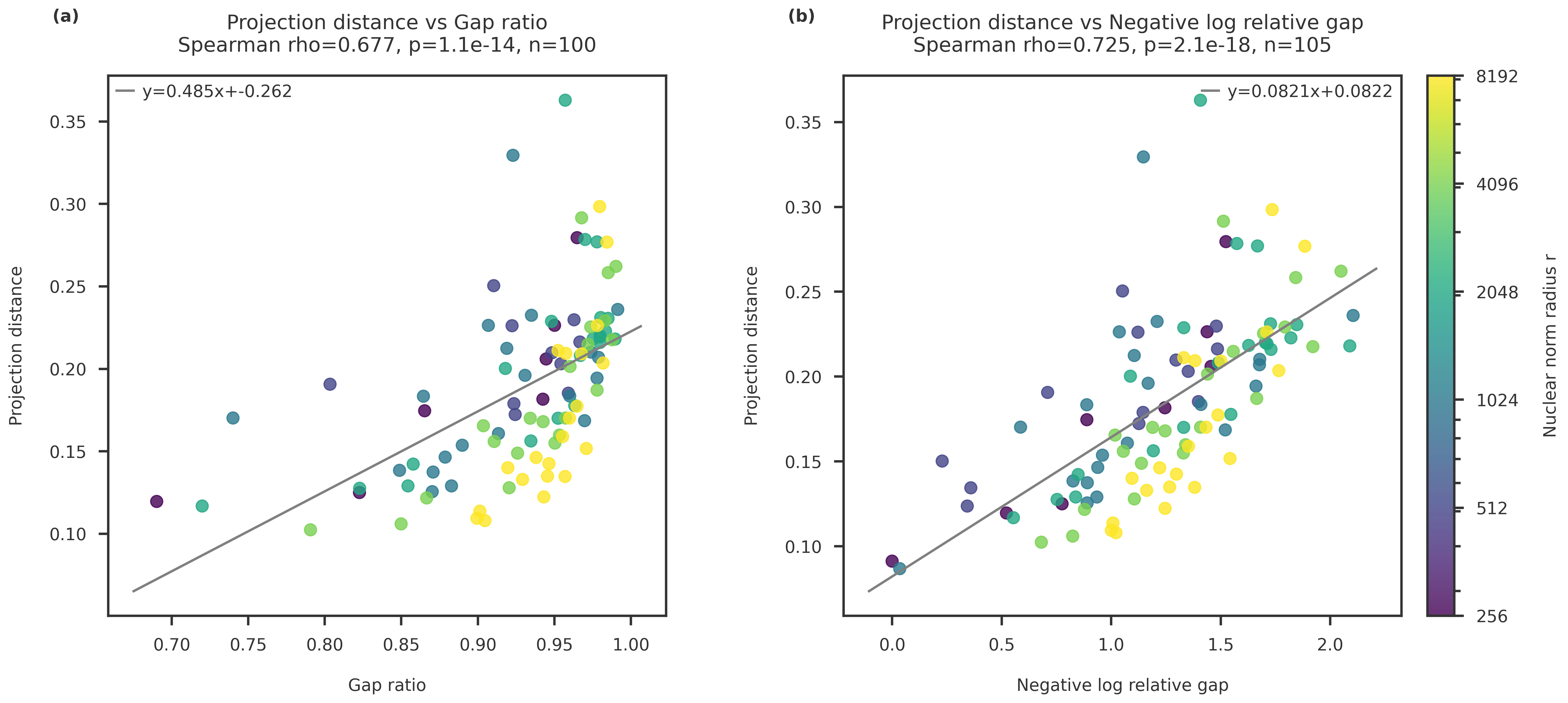
The spectral gap is the likely cause of the non-monotonicity. The top-k left-singular subspace of is only well-identified when \sigma_k(X) - \sigma_{k+1}(X) is large (Davis-Kahan). When that gap is small, tiny differences between halves rotate U_k a lot, and projection_distance blows up.

In the above plots, we show the projection distances below a certain threshold, and observe that they are directly correlated with the gap ratio \sigma_{k+1}(X) / \sigma_{k}(X). A high gap ratio indicates that the successive singular values are not well-separated, and hence the singular subspaces are not well-identified (large projection distance).