PGC v1.5 / v1.6 shrinked noise covariance

Author

Saikat Banerjee

Published

June 12, 2026

Abstract
This adds shrinked noise covariance to the versioned PGC input files used by the Clorinn v2 pipeline.
Code
import os
import json
from pathlib import Path
import numpy as np
import pandas as pd

import matplotlib.pyplot as plt
from pymir import mpl_stylesheet
from pymir import mpl_utils
mpl_stylesheet.banskt_presentation(splinecolor='black', dpi=300, colors='kelly')
from matplotlib import colormaps as mpl_cmaps
import matplotlib.colors as mpl_colors
from mpl_toolkits.axes_grid1 import make_axes_locatable

Configuration and input files

The input files are taken from v1.1 and v1.2. Click here to view the v1.1 and v1.2 data processing notebook.

The output files are versioned using outsuffix = "v1_5" / "v1_6" and written to pgc_v1.5/ and pgc_v1.6/.

Code
datadir = "/gpfs/commons/groups/knowles_lab/data/PsychGen/input"
inputdir    = Path(datadir) / "pgc_v1.3"
inputsuffix = "v1_3"
outdir      = Path(datadir) / "pgc_v1.5"
outsuffix   = "v1_5"

# Input files
zscore_file    = Path(inputdir) / f"zscore_{inputsuffix}.csv"
noise_cov_file = Path(inputdir) / f"sampling_covariance_{inputsuffix}.csv"
category_file  = Path(inputdir) / f"trait_to_group_{inputsuffix}.json"

# Output files
def ensure_parent(path):
    Path(path).parent.mkdir(parents=True, exist_ok=True)


shrinked_noise_cov_outfile = Path(outdir) / f"shrinked_noise_covariance_{outsuffix}.csv"
ensure_parent(shrinked_noise_cov_outfile)

# Read files
def load_zscore(zscore_path):
    df = pd.read_csv(Path(zscore_path), header=0, index_col=0, dtype={0: str})
    df.index = df.index.map(str)
    df.columns = df.columns.map(str)
    return df

Z_df = load_zscore(zscore_file)
A_df = pd.read_csv(noise_cov_file, header = 0, index_col=0)
with open(category_file, "r") as f:
    trait_to_group = json.load(f)

Load intercept SE from LDSC results

Code
def normalize_trait_name(name):
    rename_map = {
        "Saxena": "Daytime_sleepiness",
    }
    if not isinstance(name, str):
        return name
    name = name.replace("-", "_")
    name = rename_map.get(name, name)
    return str(name)
    

def get_matrix_df_from_json(fpath, check_sanity=True):
    with open(Path(fpath), "r") as f:
        d = json.load(f)
    rows = []
    traits = []
    for a_vs_b, val in d.items():
        trait_a, trait_b = ([normalize_trait_name(x) for x in a_vs_b.split("_vs_")])
        traits.append(trait_a)
        traits.append(trait_b)
        rows.append({
            "trait_a": trait_a,
            "trait_b": trait_b,
            "rg": val,
        })
    traits = sorted(list(set(traits)))
    df = pd.DataFrame(rows)

    n = len(traits)
    R = pd.DataFrame(np.nan, index=traits, columns=traits, dtype=float)
    R.values[R.index.get_indexer(df["trait_a"]),
             R.columns.get_indexer(df["trait_b"])] = df["rg"].to_numpy()
    R.values[R.index.get_indexer(df["trait_b"]),
             R.columns.get_indexer(df["trait_a"])] = df["rg"].to_numpy()

    if check_sanity:
        # Max and min values
        print(f"max={R.max().max():.3g}, min={R.min().min():.3g}")
        # Symmetry sanity (in case the input accidentally contains BOTH directions)
        asym = np.nanmax(np.abs(R.values - R.values.T))
        print(f"max |R - R.T| = {asym:.3g}")   # expect 0.0 if each pair listed once
        
        # Coverage: how many off-diagonal pairs are actually populated?
        off = ~np.eye(len(traits), dtype=bool)
        print(f"populated off-diagonal fraction: {np.isfinite(R.values[off]).mean():.3f}")
        
    return R

A_se_df = get_matrix_df_from_json(Path(datadir) / "ldsc_results/gcov_int_se.txt")
max=0.0872, min=0.00397
max |R - R.T| = 0
populated off-diagonal fraction: 0.951

Shrink the noise covariance

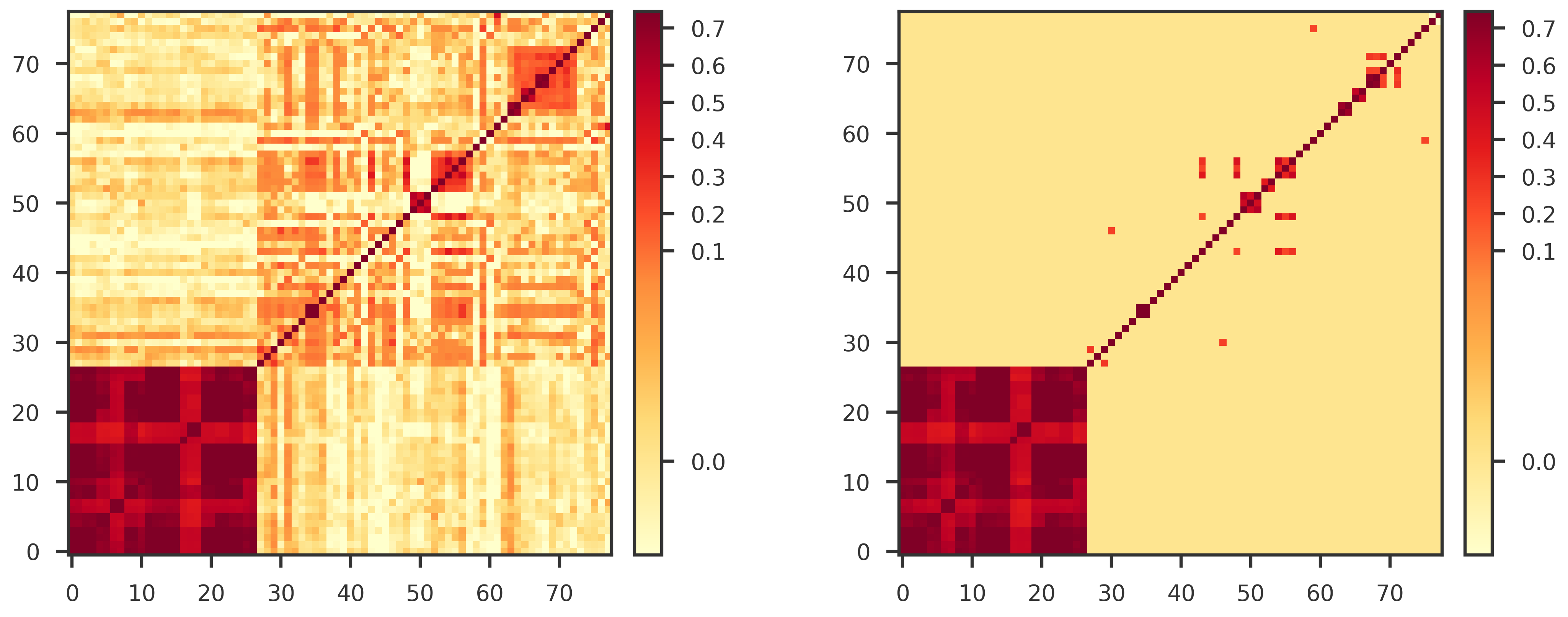
Here, we follow the same method as in GLEANR: - Blockify - Strimmer shrinkage

Code
from clorinn.utils.covariance_shrinkage import shrink_covariance

A_shrinked_df, info = shrink_covariance(
    A_df,
    A_se_df,
    block_covar=0.2,
    use_correlation_scale=True,
    return_info=True,
)

info
{'gamma': 0.00011848241155755767,
 'numerator': 0.040765216089706936,
 'denominator': 344.06132989539606,
 'n_pairs_used': 378,
 'use_correlation_scale': True,
 'block_covar': 0.2,
 'n_blocks': 12,
 'block_sizes': [27, 3, 2, 4, 2, 2, 2, 2, 2, 2, 5, 2],
 'input_diag_min': 0.9876,
 'input_diag_max': 1.0607}

How different is the shrinked noise covariance?

Code
def make_heatmap_figure(A, B):
    
    def get_mpl_norm(X):
        X = np.asarray(X)
        offdiag = ~np.eye(X.shape[0], X.shape[1], dtype=bool)
        ok = np.isfinite(X) & offdiag
        vmin = np.quantile(X[ok], 0.1)
        vmax = np.quantile(X[ok], 0.95)
        # vmax = np.max(X[ok])
        vcenter = np.quantile(X[ok], 0.75)
        if not vmin > vcenter > vmax:
            ok_nz = ok & (X != vmin)
            vcenter = np.quantile(X[ok_nz], 0.75)
            vmax = np.quantile(X[ok_nz], 0.95)
        return mpl_colors.TwoSlopeNorm(vmin=vmin, vcenter=vcenter, vmax=vmax)
        
    
    A = A.to_numpy()
    B = B.to_numpy()
    
    fig = plt.figure(figsize = (16,8))
    gs  = fig.add_gridspec(nrows=1, ncols=2, wspace=0.4, hspace=0)
    ax1 = fig.add_subplot(gs[0, 0])
    ax2 = fig.add_subplot(gs[0, 1])

    cmap1 = mpl_cmaps.get_cmap("YlOrRd").copy()

    im1 = ax1.imshow(A, cmap=cmap1, norm=get_mpl_norm(A), origin='lower')
    divider = make_axes_locatable(ax1)
    cax = divider.append_axes("right", size="5%", pad=0.2)
    cbar = plt.colorbar(im1, cax=cax, fraction=0.1)

    im2 = ax2.imshow(B, cmap=cmap1, norm=get_mpl_norm(A), origin='lower')
    divider = make_axes_locatable(ax2)
    cax = divider.append_axes("right", size="5%", pad=0.2)
    cbar = plt.colorbar(im2, cax=cax, fraction=0.1)

    plt.show()
    
make_heatmap_figure(A_df, A_shrinked_df)

Validate sampling covariance

The sampling covariance must be numerically well behaved for the correlated-noise Clorinn objective.

We check for symmetry and positive definiteness.

A symmetric positive-definite covariance is required for stable likelihood evaluation, inversion, and missingness-pattern-specific covariance operations downstream.

Code
tol = 1e-8
A = A_shrinked_df.to_numpy()
is_symmetric = np.allclose(A, A.T, atol=tol, rtol=0)
if is_symmetric:
    print("This matrix is symmetric.")
else:
    print("This matrix is not symmetric.")
    max_asymmetry = np.abs(A - A.T).max()
    print("max_asymmetry:", max_asymmetry)

eigvals = np.linalg.eigvalsh((A + A.T) / 2)
is_pd = np.all(eigvals > 0)

if is_pd:
    print ("This matrix is PD.")
else:
    print ("This matrix is not PD.")
    print (f"Minimum eigenvalue: {eigvals.min():g}")
    print ("Zero / Negative eigenvalues:")
    print(eigvals[eigvals <= 0])
This matrix is symmetric.
This matrix is PD.

Write release files

The only new release files are shielded_noise_covariance_v1_3.csv and shielded_noise_covariance_v1_4.csv.

Other input files are copied from v1.1 and v1.2 respectively.
Code
# A_shrinked_df.to_csv(shrinked_noise_cov_outfile)