PGC v1.1 data preprocessing

Author

Saikat Banerjee

Published

June 6, 2026

Abstract
This notebook prepares the versioned PGC input files used by the Clorinn v2 pipeline. v1.1 removes biomarker traits, v1.2 additionally removes neurite density traits.
Code
import os
import json
from pathlib import Path
import numpy as np
import pandas as pd

import matplotlib.pyplot as plt
from pymir import mpl_stylesheet
from pymir import mpl_utils
mpl_stylesheet.banskt_presentation(splinecolor='black', dpi=300, colors='kelly')
from matplotlib import colormaps as mpl_cmaps
import matplotlib.colors as mpl_colors
from mpl_toolkits.axes_grid1 import make_axes_locatable

Configuration and input files

The input files are taken from v1.0. Click here to view the v1.0 data processing notebook.

The output files are versioned using outsuffix = "v1_1" / "v1_2" and written to pgc_v1.1/ and pgc_v1.2/.

Code
datadir = "/gpfs/commons/groups/knowles_lab/data/PsychGen/input"
inputdir    = Path(datadir) / "pgc_v1.0"
inputsuffix = "v1_0"
outdir      = Path(datadir) / "pgc_v1.2"
outsuffix   = "v1_2"

# Input files
zscore_file    = Path(inputdir) / f"zscore_{inputsuffix}.csv"
noise_cov_file = Path(inputdir) / f"sampling_covariance_{inputsuffix}.csv"
category_file  = Path(inputdir) / f"trait_to_group_{inputsuffix}.json"

# Output files
def ensure_parent(path):
    Path(path).parent.mkdir(parents=True, exist_ok=True)

zscore_outfile    = Path(outdir) / f"zscore_{outsuffix}.csv"
noise_cov_outfile = Path(outdir) / f"sampling_covariance_{outsuffix}.csv"
category_outfile  = Path(outdir) / f"trait_to_group_{outsuffix}.json"
ensure_parent(zscore_outfile)
ensure_parent(noise_cov_outfile)
ensure_parent(category_outfile)

# Read files
def load_zscore(zscore_path):
    df = pd.read_csv(Path(zscore_path), header=0, index_col=0, dtype={0: str})
    df.index = df.index.map(str)
    df.columns = df.columns.map(str)
    return df

Z_df = load_zscore(zscore_file)
A_df = pd.read_csv(noise_cov_file, header = 0, index_col=0)
with open(category_file, "r") as f:
    trait_to_group = json.load(f)

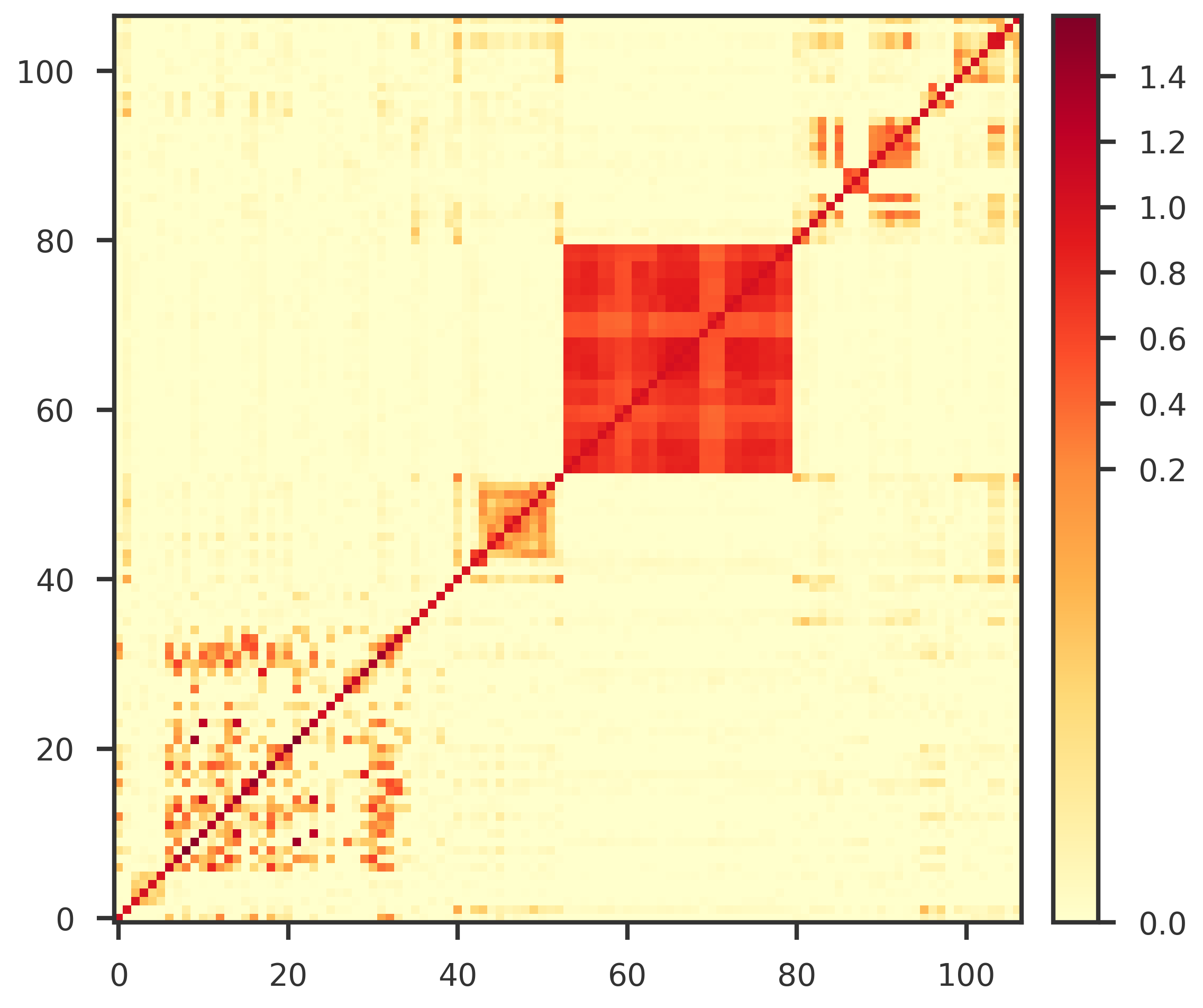
Look at the sampling covariance matrix

Code
trait_names = list(Z_df.index)
sorted_trait_names = sorted(
    trait_names,
    key=lambda trait: trait_to_group[trait]
)

A_sorted = A_df.loc[sorted_trait_names, sorted_trait_names]
A = A_sorted.to_numpy()

fig = plt.figure(figsize = (8,8))
ax1 = fig.add_subplot(111)

cmap1 = mpl_cmaps.get_cmap("YlOrRd").copy()
# norm1 = mpl_colors.TwoSlopeNorm(vcenter=np.mean(A))
norm1 = mpl_colors.TwoSlopeNorm(vmin=0, vcenter=0.2)

im1 = ax1.imshow(A, cmap=cmap1, norm=norm1, origin='lower')
divider = make_axes_locatable(ax1)
cax = divider.append_axes("right", size="5%", pad=0.2)
cbar = plt.colorbar(im1, cax=cax, fraction=0.1)


plt.show()

Code
np.unique(list(trait_to_group.values()))
array(['BMI', 'Big 5', 'Biomarker', 'Compulsive',
       'Educational attainment', 'Internalizing', 'Neurite density',
       'Neurodevelopmental', 'SCZ/BD/BPD', 'Sleep', 'Substance use',
       'Suicidality'], dtype='<U22')

Remove groups of traits

Code
groups_to_drop = [ "Biomarker" ,"Neurite density"]
keep_traits = [
    trait for trait in Z_df.index
    if trait_to_group[trait] not in groups_to_drop
]
Z_df = Z_df.loc[keep_traits]
Code
Z_df.shape
(51, 46504)

Remove redundant SNPs

  • remove SNPs with missing values in at least 15 rows (20% of 78 total remaining rows).
  • remove SNPs without significant z-score in at least 2 rows.
Code
z_thresh = 1.96 # two-sided p < 0.05

keep_cols = (
    (Z_df.isna().sum(axis=0) < 15) &
    ((Z_df.abs() > z_thresh).sum(axis=0) >= 2)
)

Z_df = Z_df.loc[:, keep_cols]
Code
Z_df.shape
(51, 38281)

Align Z-scores and sampling covariance

After dropping unavailable traits, we take the common trait set and reorder both objects consistently.

The final aligned objects are:

  • Z_aligned: traits × SNPs Z-score matrix;
  • A_aligned: traits × traits sampling covariance matrix.

These are the objects written to disk for downstream Clorinn analyses.

Code
common = A_df.index.intersection(A_df.index).intersection(Z_df.index)

# reorder consistently
A_aligned = A_df.loc[common, common]
Z_aligned = Z_df.loc[common, :]

# convert to numpy
A = A_aligned.to_numpy()
Z = Z_aligned.to_numpy()

print (f"Number of common traits: {len(common)}")
print (f"Number of SNPs: {Z.shape[1]}")
Number of common traits: 51
Number of SNPs: 38281

Validate sampling covariance

The LDSC sampling covariance must be numerically well behaved for the correlated-noise Clorinn objective.

We check for symmetry and positive definiteness.

A symmetric positive-definite covariance is required for stable likelihood evaluation, inversion, and missingness-pattern-specific covariance operations downstream.

Code
tol = 1e-8
is_symmetric = np.allclose(A, A.T, atol=tol, rtol=0)
if is_symmetric:
    print("This matrix is symmetric.")
else:
    print("This matrix is not symmetric.")
    max_asymmetry = np.abs(A - A.T).max()
    print("max_asymmetry:", max_asymmetry)

eigvals = np.linalg.eigvalsh((A + A.T) / 2)
is_pd = np.all(eigvals > 0)

if is_pd:
    print ("This matrix is PD.")
else:
    print ("This matrix is not PD.")
    print (f"Minimum eigenvalue: {eigvals.min():g}")
    print ("Zero / Negative eigenvalues:")
    print(eigvals[eigvals <= 0])
This matrix is symmetric.
This matrix is PD.

Write release files

The final release files are:

Object Output file
aligned Z-score matrix zscore_v1_1.csv / ... v1_2.csv
aligned sampling covariance sampling_covariance_v1_1.csv / ... v1_2.csv
normalized trait-category map trait_to_group_v1_1.json / ... v1_2.csv

These files define the PGC v1.1 / v1.2 input bundle used by the downstream Snakemake/Clorinn pipeline.

Code
Z_aligned.to_csv(zscore_outfile)
A_aligned.to_csv(noise_cov_outfile)

with open(category_outfile, "w") as f:
    json.dump(trait_to_group, f, indent=4, sort_keys=True)